Funnel Thinking Reconsidered: Why Your Funnel Works for Some Audiences but Not for Others
- Lukas Hassert

- 7. Okt. 2025
- 3 Min. Lesezeit

Marketers love the funnel. Awareness → Consideration → Action. It’s simple, structured, and easy to track. But reality is messier. Many campaigns succeed with one audience and fail with another—even when the funnel design is identical.
The problem? People don’t move through a funnel. They move through their own cultural and emotional logic. What converts one group can alienate another.
In this article we’ll explore:
Why traditional funnel thinking often breaks down in practice
How decision-making differs across cultural micromilieus
The role of emotional and rational drivers in conversion
How to adapt funnel stages to different audience logics
How UranosAI helps identify and resolve funnel friction
The Limits of the Classic Funnel
The funnel assumes a universal sequence: exposure leads to interest, which leads to purchase. But this only works if all customers share the same priorities and expectations.
In reality:
Some audiences look for trust and transparency before even considering a product.
Others want proof of innovation and performance before they engage.
Still others need reassurance of simplicity and security before they act.
If your funnel ignores these differences, it may look efficient on paper but fail to convert in practice.
Decision-Making as Cultural Logic
Every decision has both emotional and rational ingredients. But the balance—and meaning—of these drivers varies across micromilieus:
Belonging and identity matter most to community-oriented milieus.
Freedom and novelty inspire hedonistic and progressive groups.
Stability and tradition guide security-seeking audiences.
Price–performance logic drives value-conscious segments.
Ease of use is non-negotiable for pragmatic or older audiences.
This means your funnel must be more than a generic journey—it must be a cultural journey that adapts to the values of each group.
Where Funnels Break Down
Even with the best creative assets, funnels can fail if they do not align with the audience’s value compass:
Awareness stage: Some milieus engage with bold visuals, others prefer trusted editorial or expert content.
Consideration stage: Performance-driven groups want data and innovation; sustainability-focused groups want proof of authenticity.
Action stage: Some audiences want multiple options, others want clarity and simplicity.
Without this alignment, campaigns lose resonance—leading to drop-offs and wasted budget.
Designing Funnels That Fit Different Logics
Here are four steps to create funnels that work across audiences:
Map values first. Identify the emotional and rational drivers of your target micromilieus.
Adapt entry points. Meet audiences where they naturally engage—whether through expert voices, communities, or direct ads.
Customize consideration content. Use stories, proof points, or guarantees that reflect each milieu’s priorities.
Lower the right barriers. Identify what prevents action in each milieu—whether it’s lack of social validation, unclear pricing, or missing guarantees.
This shifts funnel thinking from one-size-fits-all to values-based conversion strategy.
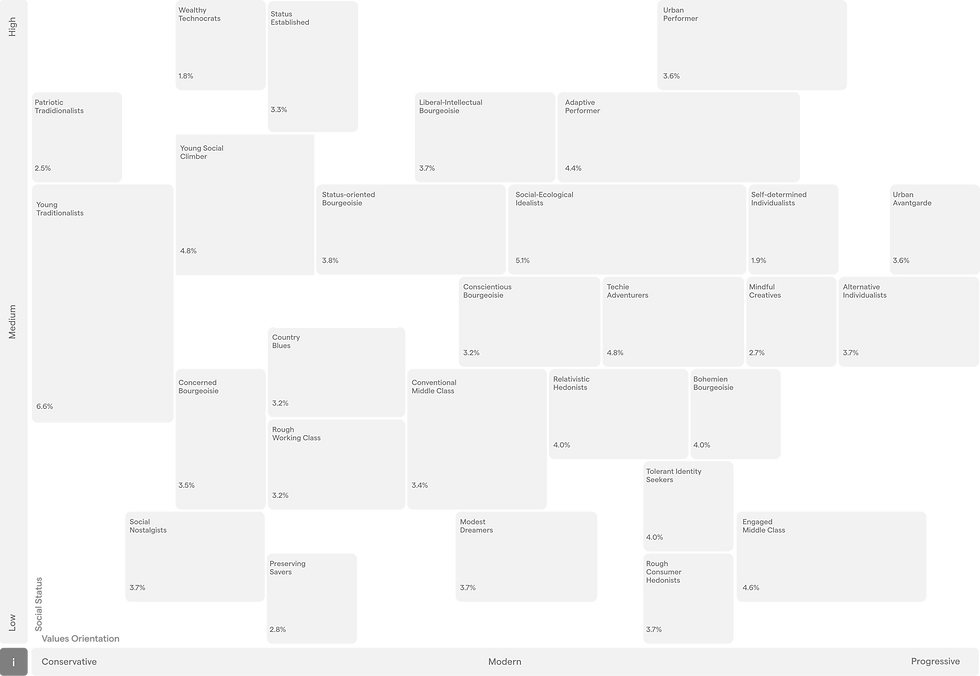
From Cultural Insight to Smarter Funnel Design
Understanding where and why a funnel creates friction begins with recognizing that conversion is not just a behavioral process — it’s a cultural one. Each micromilieu follows its own decision logic, shaped by values, trust signals, and emotional drivers. UranosAI contributes to this understanding by serving as a methodical complement to the micromilieu approach, linking behavioral data with cultural insight.
Through this lens, marketers can interpret funnel performance not just through metrics like click-through or conversion rates, but through meaning:
Which messages align with a group’s underlying motivations?
Where does the funnel break because cultural expectations differ?
How can communication adapt without losing authenticity?
Rather than automating decisions, UranosAI enhances human interpretation, revealing the value-based dynamics that determine whether a funnel feels relevant or off-key. The result is a more adaptive model — one that respects audience diversity and transforms conversion paths into genuine connection paths.
Conclusion: Funnels Should Adapt to People, Not the Other Way Around
Classic funnels are useful frameworks, but they break down when treated as universal truths. Conversion happens not because the funnel is efficient, but because it resonates with people’s values.
With micromilieus, marketers can identify the cultural logics behind decisions. With UranosAI, they can simulate and optimize funnels before wasting resources.
The result: funnels that don’t just reduce friction, but increase meaning. Funnels that connect, not just convert.
Because the most effective marketing journeys are not linear—they are cultural.
We're always curious to hear what’s on your mind—just drop us a message at info@uranos.io


